Education for Sustainable Development Is Not Education
It is agenda driven advocacy, indoctrination framed as pedagogy.
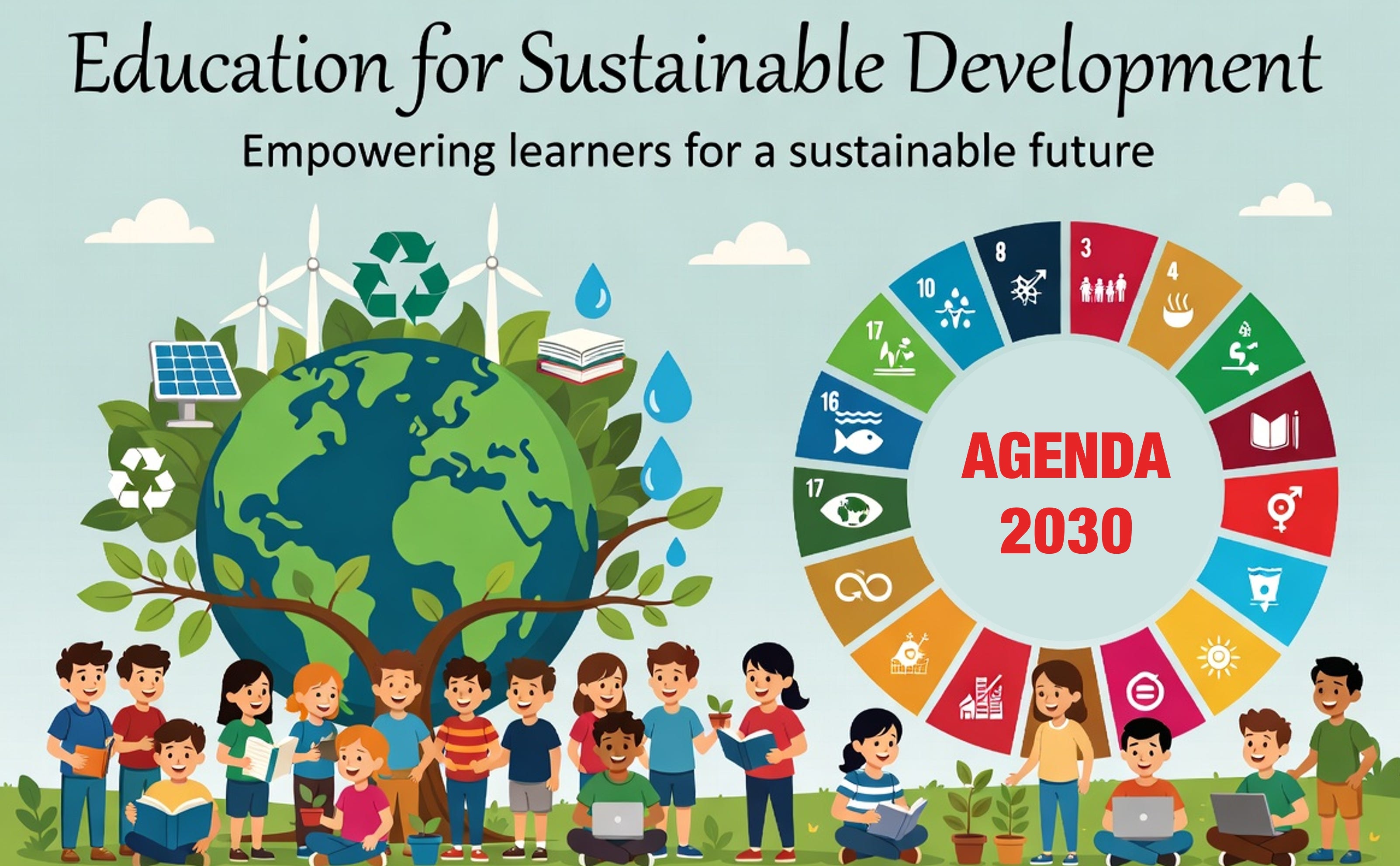
Core Distinction: Education vs. Indoctrination
Genuine education cultivates critical thinking, rationality, open inquiry, factual mastery, and the ability to evaluate competing evidence and arguments independently. It equips individuals to question assumptions, including those of their teachers or prevailing ideologies.
Indoctrination (or advocacy/propaganda in educational guise) seeks to instil specific beliefs, values, attitudes, and behaviours, often uncritically, toward a predetermined end. ESD explicitly belongs to the latter category.
From the UNESCO website:
“Education for Sustainable Development empowers people with the knowledge, skills, values, attitudes and behaviors to live in a way that is good for the environment, economy, and society. It encourages people to make smart, responsible choices that help create a better future for everyone.”
UNESCO are clearly pushing an agenda here. The “knowledge” they refer to here is the WEF/UN narrative, which is not learning ideologically neutral knowledge, but is driven by political goals. The values and attitudes are those of Critical Social Justice Theory, and the WEF/ United Nations global agenda. This is indoctrination and is delivered through a “whole school” framework – in every subject, every activity.
SDG5 on Gender Equality (which includes transgendering) forms part of the ESD curriculum.
It is explicitly “education for” an outcome (per the UN’s Agenda 2030 and SDG Target 4.7), not neutral inquiry about sustainability issues.
This “for” framing prioritizes behavioural change and activism over dispassionate analysis. Critics note it shifts from problem-oriented environmental education toward embedding anthropocentric “triple bottom line” (people-planet-profit) orthodoxy, often sidelining deeper ecological limits or trade-offs.
Key Evidence Supporting the Claim
· Prescribed Outcomes Over Open Inquiry: ESD aligns directly with the UN Sustainable Development Goals (SDGs), promoting “global citizenship,” specific lifestyles, human rights interpretations, gender equality, and “culture of peace” as settled goods. It aims to produce “sustainability change-makers” who act for predefined visions. Classical education does not subordinate itself to a political-economic agenda like Agenda 2030; it fosters skepticism toward all grand narratives.
· Critiques from Within Academia: Scholars like Helena Kopnina argue ESD risks “anthropocentric indoctrination” by prioritizing human welfare, economic development, and social equity over ecocentric concerns (e.g., intrinsic value of non-human species or biodiversity limits). It dilutes environmental education’s focus on limits to growth by embracing “sustainable development,” which can justify continued expansion. Pluralistic rhetoric in ESD often masks a dominant neoliberal or progressive framework, marginalizing dissenting views (e.g., degrowth, strict population/resource realism, or critiques of endless “green growth”).
· Fear of “Indoctrination” as a Barrier: Even proponents acknowledge the tension. Faculty sometimes resist ESD precisely because it blurs into advocacy; researchers document fears that it tells students what to think (e.g., specific actions on consumption, climate) rather than how to think.
· Whole-School/Whole-Society Integration: ESD calls for embedding its principles across curricula, teacher training, assessment, and institutions—not as one debatable topic among many, but as a holistic worldview. This resembles state-building socialisation efforts historically used for loyalty and conformity, not neutral knowledge transmission.
· Practical Implementation: Materials often link everyday choices (e.g., buying jeans) to global narratives with moral imperatives for “action,” emphasising values and behaviour modification over rigorous debate on uncertainties in climate models, economic trade-offs, technological optimism, or Malthusian vs. Cornucopian views.
Counterpoints and Rebuttals
Defenders claim ESD teaches “critical thinking” and multiple perspectives while addressing real crises. However, when the framework’s goal is predefined behavioural alignment with SDGs/UNESCO priorities, dissent on core premises (e.g., whether “sustainable development” is coherent or achievable without major trade-offs) becomes performative. Education thrives on falsifiability and contestation; ESD embeds a consensus narrative.
True environmental or scientific education presents data on pollution, biodiversity, resources, and climate without mandating specific ethical or political responses. ESD goes further by design: it is instrumental to a global policy agenda.
In short, ESD subordinates the pursuit of truth and critical faculties to shaping “correct” global citizens. That may be effective advocacy or moral formation, but it is not education as understood by thinkers from Socrates to modern liberals who prize intellectual autonomy.
In order to understand how Education for Sustainable Development is implemented in Irish education, you should check out this article.
Education for Sustainable Development in Ireland

This article should be read in conjunction with my article on the nature of Education for Sustainable Development:
References on Education for Sustainable Development
Education for sustainable development:
https://www.unesco.org/en/sustainable-development/education
UNESCO declares environmental education must be a core curriculum component by 2025
https://www.unesco.org/en/articles/unesco-declares-environmental-education-must-be-core-curriculum-component-2025
Education for the future? Critical evaluation of education for sustainable development goals
https://engage.iucn.org/system/files/2025-02/Kopnina%20Education%20for%20the%20future%20Critical%20evaluation%20of%20education%20for%20SDGs%20JEE%202020.pdf
“My job isn’t to tell them what to think”: The Fear of Indoctrination and How it Shapes Education for Sustainable Development: https://ejrsme.icrsme.com/article/view/7313/6995
The whole-school approach to education for sustainable development: From pilot projects to systemic change: https://www.developmenteducationreview.com/issue/issue-6/whole-school-approach-eduation-sustainable-development-pilot-projects-systemic-change
Revisiting Education for Sustainable Development (ESD): Examining Anthropocentric Bias Through the Transition of Environmental Education to ESD: https://onlinelibrary.wiley.com/doi/abs/10.1002/sd.529
Education for sustainable development (ESD): the turn away from ‘environment’ in environmental education?
https://www.academia.edu/807510/Education_for_Sustainable_Development_ESD_The_turn_away_from_environment_in_environmental_education
Rosa Koire: Agenda 21 (which evolved into Agenda 2030). Open Mind Conference 2013. Rosa outlines how the stick of pending climate catastrophe is being used to leverage policy at all levels to achieve the technocratic neo-fascistic objectives of the United Nations and their proponents.
Education or Indoctrination? The Violent Origins of Public School Systems in an Era of State-Building
https://www.cambridge.org/core/journals/american-political-science-review/article/education-or-indoctrination-the-violent-origins-of-public-school-systems-in-an-era-of-statebuilding/C72BC036898996925583051B4430F1BF